Article: Born in a Home in Jaipur: The Story Behind The Jaipur Wala

Born in a Home in Jaipur: The Story Behind The Jaipur Wala
There is a particular morning light in Jaipur that doesn't exist anywhere else.
It comes through sandstone and reflects off pink-washed walls and falls on the hands of artisans who have been at work since before the city woke. It's warm and golden and slightly dusty, the way Rajasthan always is, and it illuminates work — the kind of careful, deliberate, unhurried work that has been done in this place for centuries.
That light is where The Jaipur Wala begins.
Not a Factory

Every quilt, sheet set, blanket, and comforter we make is born in a home in Jaipur — not a factory.
This is not a metaphor or a marketing line. It's a literal description of our supply chain. The printing happens in workshop homes. The quilting is done by women artisans sitting in households that have practiced this craft across multiple generations. The cotton is hand-fluffed and the fills are hand-laid, not machine-filled.
When we say "made by hand," we mean the hands have names. The hands belong to people with families, with histories, with skills that took years — sometimes decades — to develop.
What Slow Textiles Means
There is a growing movement — in food, in fashion, in home goods — toward what people call "slow." Slow food. Slow fashion. Slow living. The word sounds like an aesthetic, but it's really a philosophy of production. Slow means made deliberately. Slow means made well. Slow means made by someone who cared enough to take the time.
Fast textiles — the kind that most bedding is made from — prioritise volume, uniformity, and cost reduction. They're designed to be affordable and replaceable. Slow textiles work differently. They're designed to be kept. To be used until they become completely yours — worn in, broken in, softened and aged into something even better than what you started with.
A handstitched quilt made by someone in Jaipur is not designed to be discarded. It's designed to be the quilt you point to when you're older and say, I've had that for twenty years.
The Craft: What Actually Happens

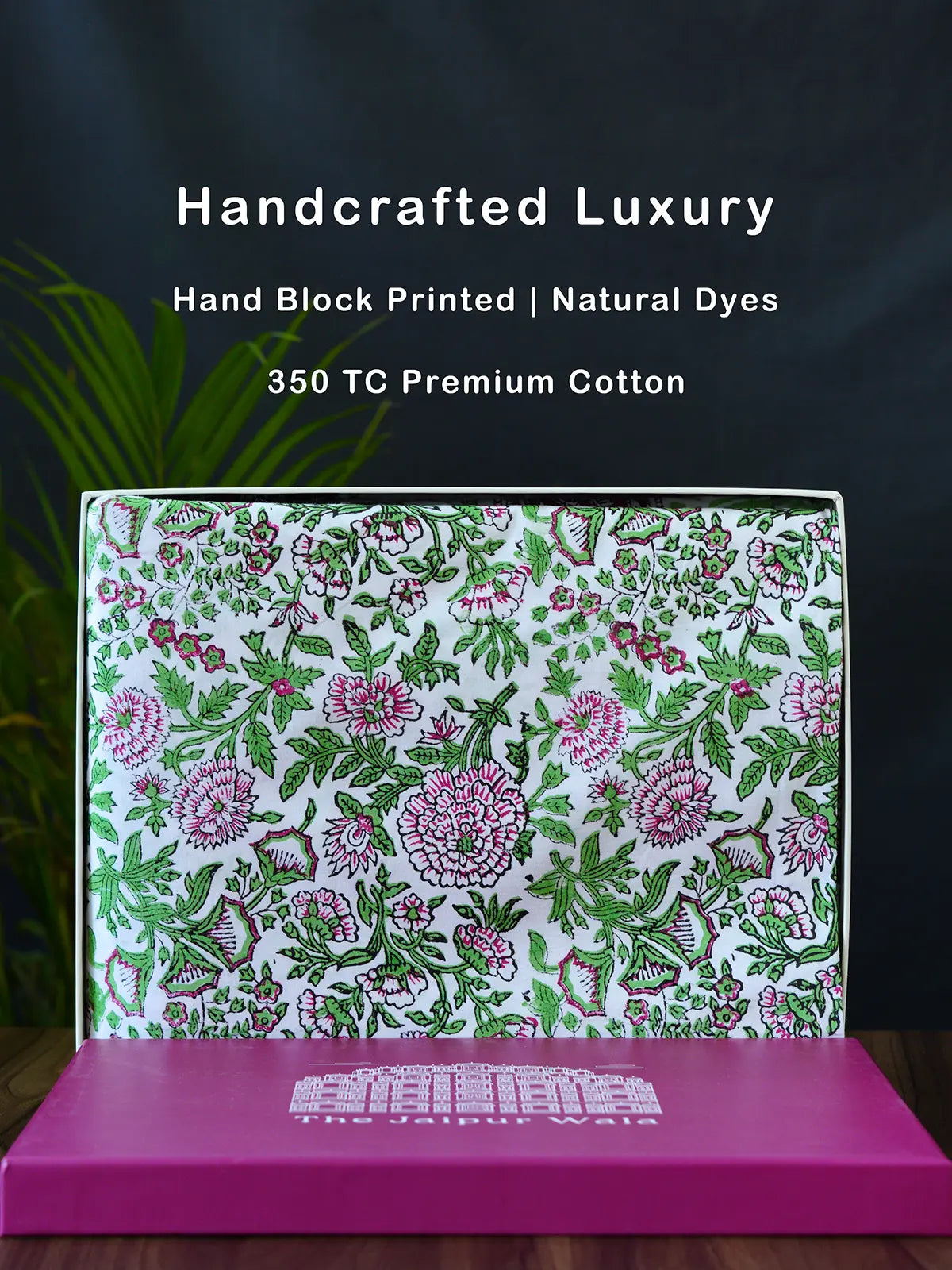
A Jaipur Wala quilt begins with a carved teak wood block. The artisan who holds it may have inherited it from a parent. The design carved into it — floral, geometric, figurative — comes from a tradition that has been passed through that family for generations.
The block is pressed into a tray of natural dye. Then onto organic cotton fabric. Then lifted. Repositioned by eye — an alignment so precise it sounds impossible until you watch someone do it hundreds of times a day — and pressed again.
For multi-colour pieces, this process is repeated for each colour, each requiring its own block and its own pass, with drying time in between. Then the fabric is washed in running water, hung in the sun, inspected, cut, and matched with its lining. The filling — surgical-grade cotton, hand-fluffed and evenly distributed — is laid between the layers. And then the quilting begins: small, tight stitches sewn entirely by hand across the surface, holding everything together.
From block to bed, a single quilt passes through a dozen pairs of hands. It takes days.
The Artisans
We are careful about the word "artisan." It gets used loosely — as a vague quality signal rather than a meaningful description. When we use it, we mean people who have spent years learning a specific skill, who practice that skill every day, and whose work is not replicable by a machine.
We pay above market rates. We work with the same artisan families year after year. We don't use seasonal labour or outsource to the lowest bidder. Consistency in our supply chain means consistency in our product — and it means the people who make our things can build stable livelihoods around doing so.
Natural Dyes: The Non-Negotiable

When we started The Jaipur Wala, we made a list of things we were not willing to compromise on. Natural dyes were at the top.
Synthetic dyes are cheaper, faster, and more consistent. They're also derived from petrochemicals, and the wastewater from synthetic dyeing is one of the major sources of industrial water pollution globally. In regions like Rajasthan, where water is a precious and contested resource, the environmental impact of irresponsible dyeing practices is not abstract — it's immediate and visible.
Natural dyes require more skill and more time. They produce colours that are less perfectly uniform. They age differently — mellowing and deepening over years of use rather than fading into grey uniformity. We chose them not despite those qualities but because of them.
The Things That Make Our Products Ours
- Everything is hand block printed. Not screen printed. Not digitally printed. Every motif was pressed onto fabric by a human hand using a carved wooden block.
- Natural dyes only. No synthetic colorants, anywhere in our range.
- Organic cotton throughout. The fill, the outer layers, the backing — all organic.
- Made in homes, not factories. We cannot offer you a factory tour, because there isn't one.
- Handstitched where it matters. The quilting on our quilts is done by hand. You can feel the stitching with your fingers.
What We Hope For You
We hope you buy something from us and keep it for a long time. We hope it gets washed so many times it becomes completely soft. We hope it goes through seasons with you — that it's on your bed in winter and folded at the foot in summer, that it travels with you when you move, that it becomes the thing guests notice and ask about.
And we hope that, at some point, it connects you to the place and the people it came from. To the morning light in Jaipur, to the artisan's hands, to a way of making things that is unhurried and deliberate and has been quietly perfect for four hundred years.
That's what we're trying to give you. That's all we're trying to give you.